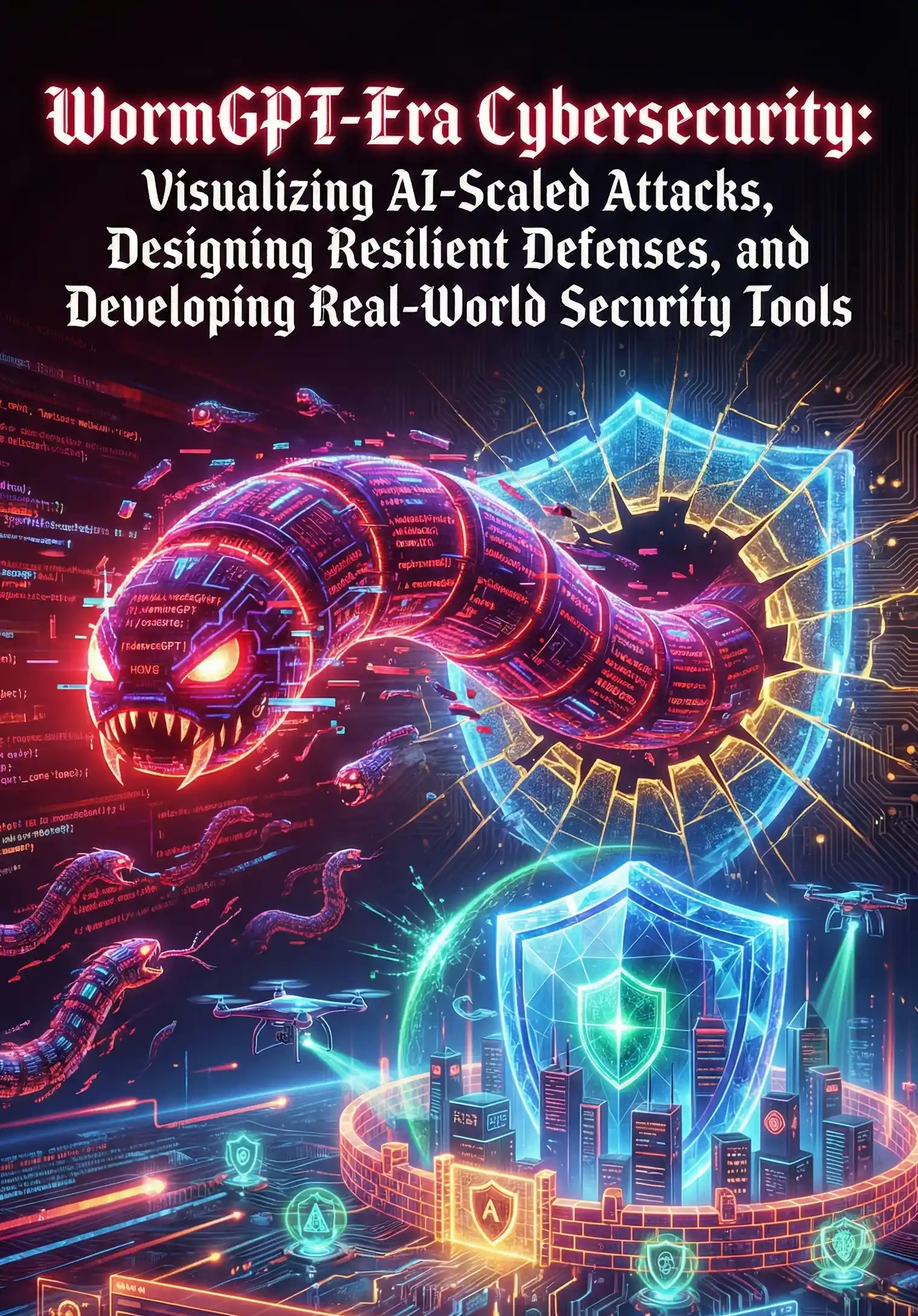
Introduction: The Unscalable Threat and the Need for Augmentation
The digital battlefield has fundamentally and irrevocably changed. For years, cybersecurity professionals operated under a paradigm of asymmetrical warfare, where a small team of skilled defenders could hold the line against a larger, but often less sophisticated, pool of attackers. The advent of generative AI-powered attack tools, exemplified by platforms like WormGPT and FraudGPT, has shattered this paradigm. We have entered an era of AI-scaled attacks, where adversaries can generate polymorphic malware, craft hyper-realistic phishing campaigns, and discover zero-day vulnerabilities at a speed and scale that defies human comprehension. This is the unscalable threat, a deluge of sophisticated, automated attacks that traditional Security Operations Centers (SOCs) are ill-equipped to handle.
The core of the problem lies in the limitations of human capacity. A human analyst, no matter how skilled, can only process a finite amount of information. Yet, modern enterprise networks generate terabytes of log data daily. The resulting alert fatigue is a well-documented crisis, leading to analyst burnout and, critically, missed threats. The velocity of these new attacks, often executing in seconds, renders manual threat detection and response processes obsolete. Compounding this issue is the persistent cybersecurity skills gap, a chronic shortage of qualified professionals that leaves defensive teams perpetually understaffed and overwhelmed. The traditional blue team model, reliant solely on human intellect and endurance, is simply not sustainable against a machine-powered adversary.
graph TD;
    subgraph "Adversary Evolution";
        A1[Human-Operated Attacks] --> A2[Automated Scripting];
        A2 --> A3[Generative AI Attacks <br><i>(e.g., WormGPT)</i>];
    end
    subgraph "Defense Capacity";
        D1[Manual Log Review] --> D2[SIEM & SOAR];
        D2 --> D3["Human Cognitive Limit <br><i>(The Scalability Wall)</i>"];
    end
    A3 -- Creates --> V[Exponential Threat Volume <br> & Sophistication];
    V -- Overwhelms --> D3;
    style V fill:#ff9999,stroke:#333,stroke-width:2px;
    style D3 fill:#ffcccc,stroke:#333,stroke-width:2px;
This challenging new reality does not signal the obsolescence of the human analyst. Rather, it underscores the urgent need for a new operational model: analyst augmentation. The central thesis of the AI-powered blue team is not to replace human intuition and strategic thinking but to amplify it. In this symbiotic model, AI and machine learning algorithms serve as a force multiplier, tirelessly performing the high-volume, low-complexity tasks that consume the majority of an analyst's time. AI can triage alerts with superhuman speed, correlate disparate events across massive datasets to uncover hidden attack patterns, and provide concise, context-rich summaries for human review. This frees human experts to focus on what they do best: complex threat hunting, strategic incident response, forensic analysis, and creative defensive engineering.
This chapter will explore the practical applications of this augmented approach. We will move beyond the theoretical to examine how AI is being integrated into modern SOC workflows, from intelligent alert prioritization and automated evidence gathering to AI-driven threat modeling and response orchestration. By embracing security automation and intelligent augmentation, we can begin to scale our defenses to meet the challenge of the WormGPT era, transforming the blue team from a reactive firefighting unit into a proactive, resilient, and AI-empowered security force.
References
- ISC². (2023). Cybersecurity Workforce Study. Retrieved from https://www.isc2.org/Research/Workforce-Study
- Sarker, I. H., Kayes, A. S. M., Badsha, S., Alqahtani, H., Watters, P., & Ng, A. (2020). Cybersecurity data science: a systematic review of data-driven innovation in cybersecurity. Journal of Big Data, 7(1), 1-29.
- Bace, R., & Mell, P. (2001). NIST Special Publication on Intrusion Detection Systems. National Institute of Standards and Technology.
- O'Reilly, T. (2017). WTF: What's the Future and Why It's Up to Us. Harper Business.
- Caltagirone, S., Pendergast, A., & Betz, C. (2013). The Diamond Model of Intrusion Analysis. Applied Network Solutions.