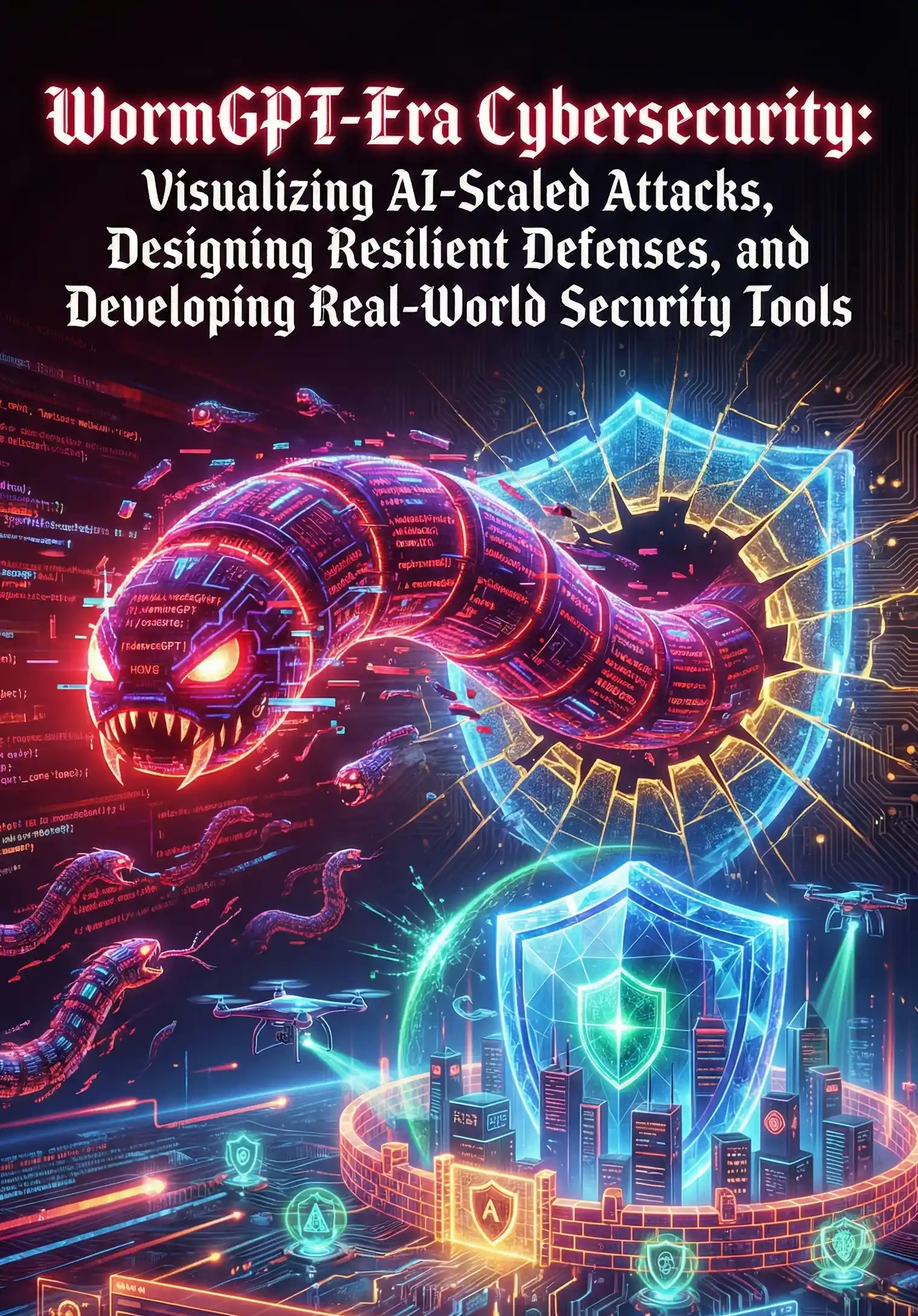
Introduction: Redefining the Cyber Kill Chain with AI
For decades, the Lockheed Martin Cyber Kill Chain has served as the foundational model for cybersecurity professionals, providing a sequential framework to understand and disrupt adversary operations. This seven-step process—from initial reconnaissance to the final actions on objectives—has been instrumental in designing defensive strategies. However, the emergence of sophisticated artificial intelligence, particularly generative AI models and concepts like WormGPT, is forcing a radical re-evaluation of this linear paradigm. The age of AI-augmented attacks is upon us, fundamentally altering the speed, scale, and sophistication of cyber threats.
AI does not merely assist attackers; it acts as a force multiplier, compressing the attack timeline, automating previously labor-intensive tasks, and scaling malicious operations far beyond human capability. This shift transforms the methodical, human-driven kill chain into a dynamic, intelligent, and often autonomous attack lifecycle. Instead of a linear progression, we now face a high-velocity, self-optimizing loop where AI enhances every stage, learning from the environment and adapting its tactics in real-time.
The impact is felt across the entire attack surface. AI-powered reconnaissance tools can perform automated OSINT (Open-Source Intelligence), scan vast IP ranges for vulnerabilities, and build highly detailed target profiles in minutes. In the weaponization phase, generative AI can create polymorphic malware that constantly alters its code to evade signature-based detection, or craft flawless, context-aware spear-phishing emails that are virtually indistinguishable from legitimate communication. This dramatically lowers the barrier to entry for less-skilled actors and equips advanced persistent threats (APTs) with unprecedented capabilities.
Once an exploit is delivered, the AI's role shifts to autonomous execution. An AI agent can probe for weaknesses, select the most effective exploit from its arsenal, and execute it without human intervention. Post-compromise, these intelligent agents can perform lateral movement, identify and exfiltrate valuable data, and deploy ransomware with unparalleled speed, all while learning from network defenses to improve evasion techniques. This evolution demands a new visualization, moving from a simple chain to an intelligent, cyclical process.
graph TD;
    subgraph AI-Augmented Kill Cycle
        A[Reconnaissance] -- AI-Powered OSINT & Scanning --> B[Weaponization];
        B -- Generative Malware & Phishing --> C[Delivery];
        C -- Adaptive Targeting --> D[Exploitation];
        D -- Autonomous Execution --> E[Installation];
        E -- ML-Based Evasion --> F[Command & Control];
        F -- Dynamic C2 Channels --> G[Actions on Objectives];
    end

    G -.-> H{Learn & Adapt};
    H -- Re-tasking & Optimization --> A;

    style H fill:#d4edda,stroke:#155724,stroke-width:2px;
As the diagram illustrates, the critical change is the introduction of a feedback loop, transforming the chain into a cycle. The outcome of an attack ('Actions on Objectives') provides new data that the AI uses to 'Learn & Adapt', refining its methods for the next iteration. In this new era of AI-scaled attacks, understanding this redefined, intelligent kill cycle is the first critical step toward designing resilient defenses. The following sections will deconstruct these advanced attacks, providing the insights necessary to build the next generation of cybersecurity tools and strategies.
References
- Hutchins, E. M., Cloppert, M. J., & Amin, R. M. (2011). Intelligence-Driven Computer Network Defense Informed by Analysis of Adversary Campaigns and Intrusion Kill Chains. Lockheed Martin Corporation.
- Brundage, M., Avin, S., Clark, J., et al. (2018). The Malicious Use of Artificial Intelligence: Forecasting, Prevention, and Mitigation. Future of Humanity Institute, University of Oxford.
- European Union Agency for Cybersecurity (ENISA). (2023). Threat Landscape for Artificial Intelligence. ENISA Publications.
- O'Brien, J. (2023). How Generative AI is Supercharging Cybersecurity—and Cybercrime. MIT Sloan Management Review.
- Brown, T. B., et al. (2020). Language Models are Few-Shot Learners. Advances in Neural Information Processing Systems, 33, 1877-1901.