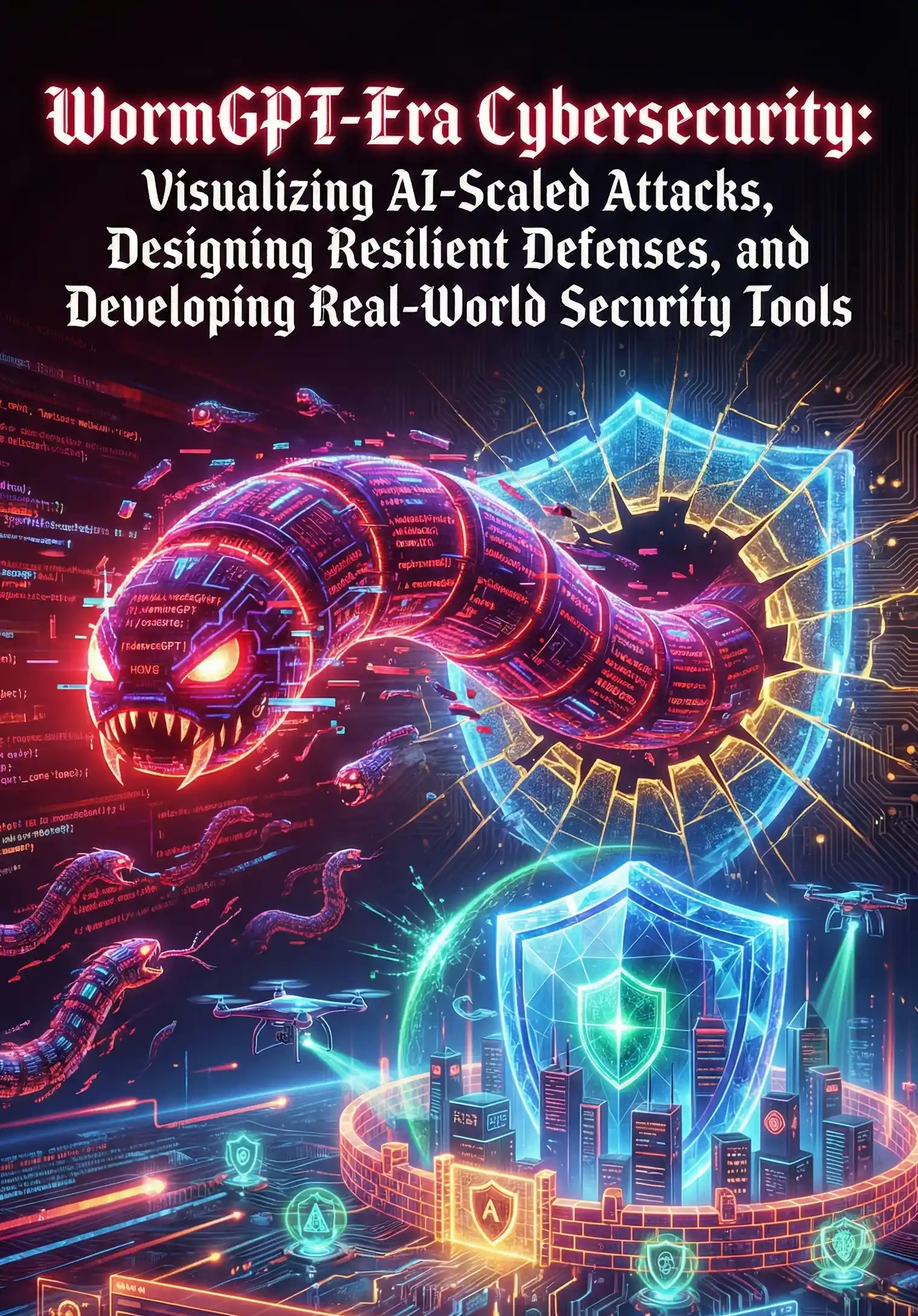
The Paradigm Shift: Why WormGPT Invalidates Traditional Security Models
For decades, enterprise cybersecurity has been architected around a principle best described as the 'castle-and-moat' model. This traditional security paradigm relies on a fortified perimeter (firewalls, gateways), vigilant guards (Intrusion Detection Systems), and a catalog of known enemy tactics (signature-based antivirus). The core assumption has always been that attackers, while sophisticated, operate at a human pace. Reconnaissance, exploit development, and campaign execution were resource-intensive, creating a temporal gap that defenders could exploit. This foundational assumption is now being systematically dismantled by the advent of autonomous, AI-driven cyber threats, exemplified by the concept of WormGPT.
The emergence of generative AI in the cyber domain represents not merely an evolution but a fundamental paradigm shift. WormGPT and similar AI models are not just new tools in an attacker's arsenal; they are autonomous agents capable of orchestrating the entire attack lifecycle at machine speed and scale. They invalidate traditional security models by attacking their weakest points: their reliance on historical data, static rules, and the limited bandwidth of human analysts. This section explores precisely how these AI-driven cyberattacks render long-standing defensive strategies obsolete.
The following diagram illustrates the stark contrast between the traditional, human-gated cyberattack chain and the hyper-accelerated, autonomous loop enabled by a WormGPT-class AI.
graph TD
    subgraph Traditional Attack Lifecycle (Human-Paced)
        A[Reconnaissance] --> B[Weaponization];
        B --> C[Delivery];
        C --> D[Exploitation];
        D --> E[C2 & Exfiltration];
    end

    subgraph WormGPT-Era Attack Lifecycle (Machine-Speed)
        F[Autonomous Recon & Vulnerability Discovery] --> G[AI-Generated Polymorphic Payload];
        G --> H[Hyper-Personalized Delivery];
        H --> I[Automated Exploitation & Lateral Movement];
        I --> J[Adaptive C2 & Automated Goal Execution];
        J --> F;
    end
The most immediate casualty of the WormGPT era is signature-based detection. Legacy antivirus and IDS/IPS solutions function by matching files and network traffic against a vast database of known malware signatures—digital fingerprints of malicious code. Generative AI completely nullifies this approach. A WormGPT-like agent can generate functionally identical but syntactically unique malware payloads for every single target, a concept known as 'polymorphic' or 'metamorphic' code. With each instance being novel, there is no pre-existing signature to match. The static library of threats becomes an outdated history book in the face of an adversary that writes a new story every millisecond.
Perimeter defenses and human-centric security awareness training are similarly undermined. The 'moat' was designed to repel known attack vectors and crudely crafted phishing attempts. WormGPT, however, can leverage its Large Language Model (LLM) capabilities to conduct advanced reconnaissance on social media and corporate websites, then craft perfectly contextualized, linguistically flawless business email compromise (BEC) and spear-phishing attacks. These hyper-personalized messages can bypass email filters and are far more likely to deceive even well-trained employees, effectively turning the human element from a line of defense into an unwitting entry point.
Finally, the traditional model's reliance on the 'human-in-the-loop' for incident response is overwhelmed by the sheer velocity and volume of AI-scaled attacks. A Security Operations Center (SOC) analyst, however skilled, cannot triage, investigate, and respond to thousands of simultaneous, adaptive, and unique intrusion attempts. The OODA loop (Observe, Orient, Decide, Act) of the human defender is simply too slow. WormGPT operates on a machine-based OODA loop, capable of autonomously discovering a vulnerability, generating an exploit, deploying it, and moving laterally across a network before a human analyst has even finished reading the initial alert.
This invalidation of foundational security principles necessitates a complete rethinking of cyber defense. The paradigm must shift from a reactive posture of 'prevent and detect' to a proactive strategy of 'assume breach' and continuous response. Resilience, adaptation, and AI-driven defense are no longer forward-thinking concepts; they are the baseline requirements for survival in the WormGPT era.
References
- Brundage, M., et al. (2023). The Malicious Use of Artificial Intelligence: Forecasting, Prevention, and Mitigation. OpenAI & Future of Humanity Institute.
- Seymour, J., & Tully, P. (2017). Weaponising AI: The Dangers of Autonomous Cyber Attack. Australian Strategic Policy Institute (ASPI) Report.
- Arp, D., et al. (2014). DREBIN: Effective and Explainable Detection of Android Malware in Your Pocket. Proceedings of the 21st Annual Network and Distributed System Security Symposium (NDSS).
- Caltagirone, S. (2022). The Diamond Model of Intrusion Analysis. ThreatConnect Press.
- National Institute of Standards and Technology (NIST). (2020). Zero Trust Architecture. NIST Special Publication 800-207.