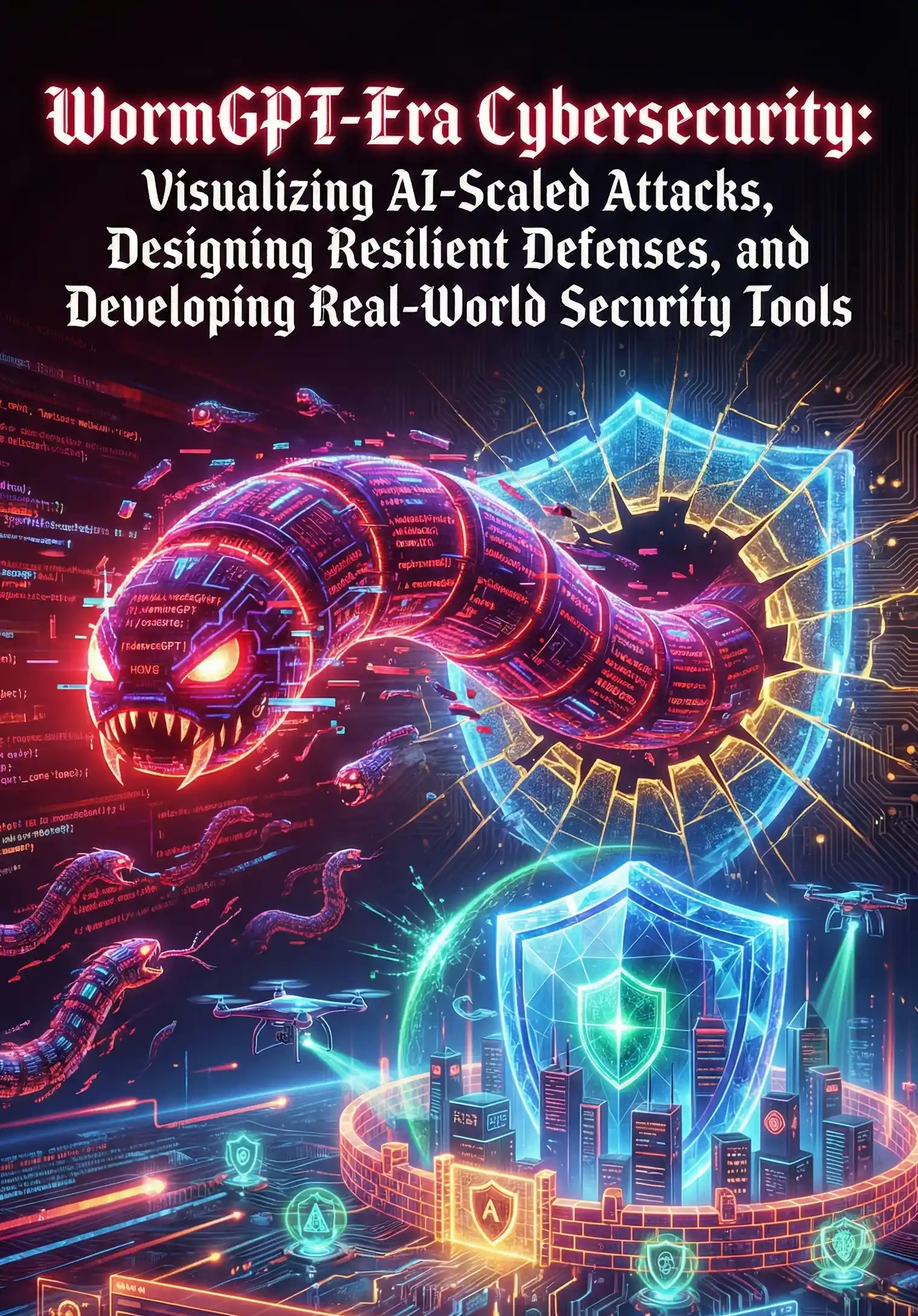
Conclusion: Acknowledging the New Reality and Setting the Stage for Defense
As we conclude this introductory chapter, one reality stands stark and undeniable: the dawn of the WormGPT era represents a fundamental paradigm shift in cybersecurity, not merely an incremental advancement in threat actor tooling. The emergence of generative AI and large language models (LLMs) as weapons has permanently altered the threat landscape, moving us from human-speed, handcrafted attacks to the chilling potential of autonomous, AI-scaled cyber warfare. The theoretical 'what if' has become the practical 'what now,' and our defensive strategies must evolve with commensurate urgency and sophistication.
The new reality is defined by threats that are autonomous, adaptive, and accessible. Autonomous cyber agents, powered by LLMs, can independently conduct reconnaissance, craft hyper-personalized phishing campaigns at scale, identify zero-day vulnerabilities, and generate polymorphic code to evade signature-based detection. This capability for adaptive evasion means that static, rule-based defenses are becoming increasingly obsolete. Furthermore, the democratization of these powerful tools lowers the barrier to entry, potentially equipping low-skilled actors with the capabilities of a nation-state hacking group.
graph TD
    subgraph Traditional Attack Lifecycle (Human-Paced)
        A1[Reconnaissance] --> A2[Weaponization];
        A2 --> A3[Delivery];
        A3 --> A4[Exploitation];
        A4 --> A5[Command & Control];
    end

    subgraph WormGPT-Era Attack Lifecycle (Machine-Speed & Autonomous)
        B1[Initial Objective Prompt] --> B2[AI-Driven Autonomous Recon];
        B2 --> B3[Self-Propagating & Polymorphic Payload Generation];
        B3 --> B4{Adaptive Lateral Movement & Evasion};
        B4 --> B2;
        B4 --> B5[Automated Objective Execution];
    end

    style A1 fill:#cce5ff,stroke:#333,stroke-width:2px
    style B1 fill:#ffcdd2,stroke:#333,stroke-width:2px
This new paradigm renders traditional, perimeter-focused security insufficient. Acknowledging this reality is the first and most critical step toward building effective defenses. The challenge is no longer just about preventing intrusion but about ensuring operational resilience in an environment where compromise may be inevitable. The speed and scale of AI-driven cyberattacks demand an equivalent, machine-speed response that human operators alone cannot provide.
Therefore, we must set the stage for a new generation of defense. The chapters that follow will move beyond acknowledging the problem to architecting the solution. We will explore the vital pivot towards AI-for-AI defense, where we leverage our own machine learning models to detect and neutralize malicious AI. We will delve into the principles of Zero Trust architecture, designing systems that are inherently distrustful and validate every transaction. Finally, we will equip you with the methodologies for proactive threat hunting and the frameworks for building truly resilient cyber-physical systems. The era of WormGPT is here, but with foresight, innovation, and a commitment to new defensive philosophies, we can prepare to meet its challenge head-on.
References
- Buchanan, B. (2017). The Cybersecurity Dilemma: Hacking, Trust and Fear Between Nations. Oxford University Press.
- GPT-4. (2023). System Card: Potential for Risky Emergent Behaviors. OpenAI. Retrieved from openai.com.
- National Institute of Standards and Technology (NIST). (2020). Zero Trust Architecture (NIST SP 800-207). U.S. Department of Commerce.
- European Union Agency for Cybersecurity (ENISA). (2023). Threat Landscape for Artificial Intelligence. ENISA Publications.
- Clarke, R. A., & Knake, R. K. (2019). The Fifth Domain: Defending Our Country, Our Companies, and Ourselves in the Age of Cyber Threats. Penguin Press.