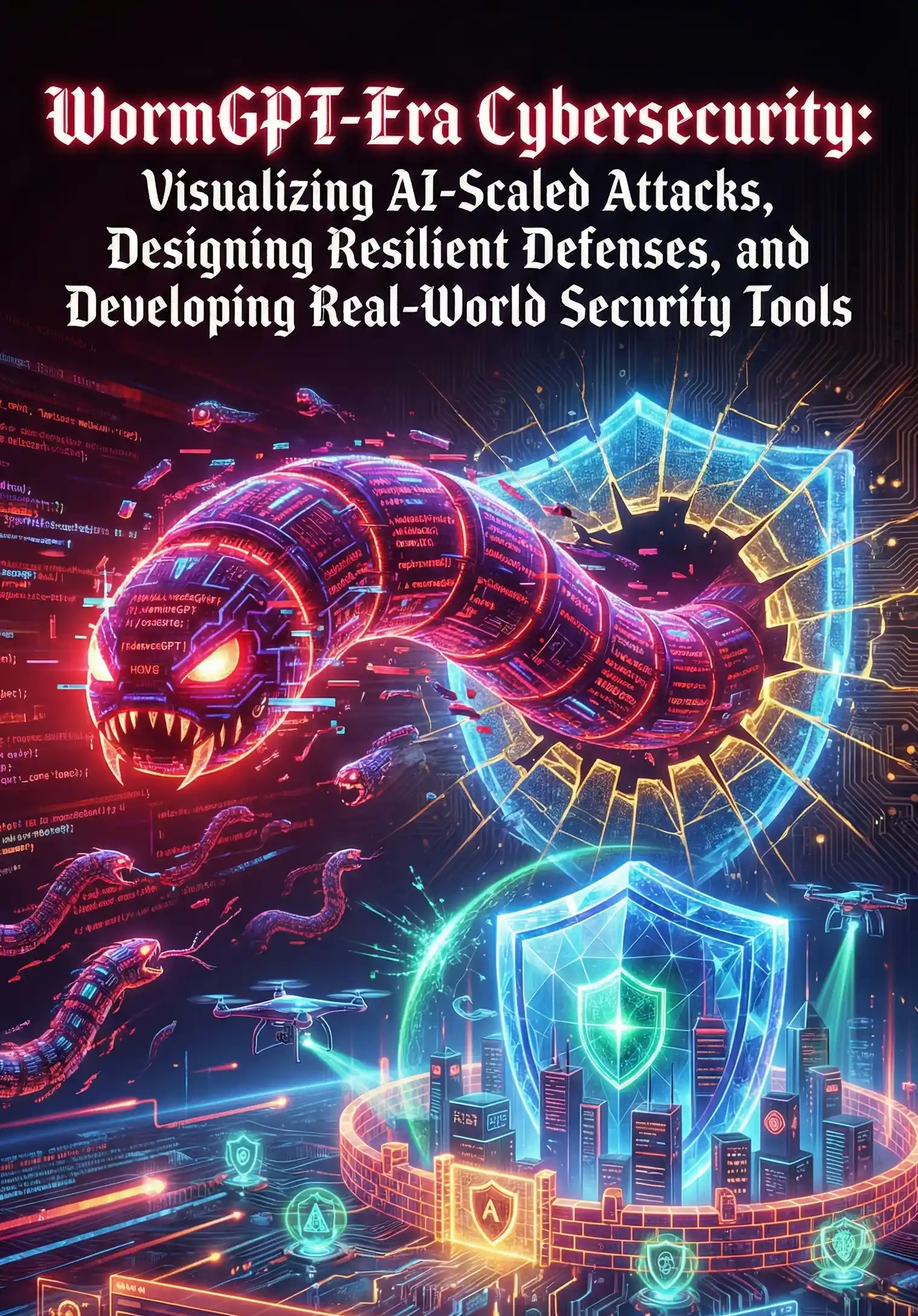
The term "WormGPT" signifies more than a singular tool; it represents a new class of AI-driven cyberattacks characterized by a potent trifecta of capabilities: autonomy, self-propagation, and hyper-realistic social engineering. This convergence transforms traditional malware from a static, human-controlled weapon into a dynamic, intelligent, and scalable adversary. Understanding these core capabilities is fundamental to designing the next generation of resilient cyber defenses needed to counter generative AI threats.
The primary paradigm shift in the WormGPT era is the introduction of true autonomy. Unlike scripted malware, which follows a predefined set of instructions, an AI-powered agent can make independent decisions in real-time. This autonomous malware leverages Large Language Models (LLMs) and other machine learning algorithms to perceive, orient, decide, and act within a target environment. It can perform reconnaissance, analyze system configurations, identify novel vulnerabilities, and execute a chosen attack path without direct human intervention. This process, often modeled after the military's OODA loop (Observe, Orient, Decide, Act), allows the threat to adapt to security countermeasures, pivot to new targets, and optimize its strategy for maximum impact.
graph TD
    A[Observe]
    B[Orient]
    C[Decide]
    D[Act]

    A -- Data Collection & Recon --> B
    B -- Analyze & Contextualize --> C
    C -- Select Attack Vector --> D
    D -- Execute & Exploit --> A

    subgraph AI Attack Agent
        A(Scan Network & Enumerate Services)
        B(Identify Vulnerabilities & Defenses)
        C(Choose Exploit & Generate Payload)
        D(Deploy Payload & Propagate)
    end
The "worm" component of WormGPT builds upon the legacy of self-propagating threats like Morris and Stuxnet but amplifies their reach and sophistication with AI. Once an AI agent compromises an initial host, it doesn't wait for commands. Instead, it uses the host's resources to autonomously replicate and spread. This involves scanning the network for new targets, using its autonomous decision-making to tailor exploits for different operating systems or software versions, and leveraging compromised credentials to move laterally. The AI's ability to craft polymorphic code on the fly makes each new instance of the worm slightly different, frustrating signature-based detection and traditional antivirus solutions.
class AI_Worm:
    def __init__(self, initial_target):
        self.compromised_hosts = set()
        self.target_queue = [initial_target]

    def run_attack_cycle(self):
        while self.target_queue:
            current_target = self.target_queue.pop(0)
            if self.compromise(current_target):
                self.compromised_hosts.add(current_target)
                new_targets = self.scan_and_discover(current_target)
                for target in new_targets:
                    if target not in self.compromised_hosts:
                        self.target_queue.append(target)

    def compromise(self, target):
        // 1. Analyze target (OS, services, etc.)
        vulnerabilities = llm_identify_vulns(target.system_info)
        // 2. Select best exploit and generate payload
        exploit_code = llm_generate_exploit(vulnerabilities[0])
        // 3. Execute and confirm compromise
        return execute(target, exploit_code)

    // ... other methods for scanning, discovery, etc.